
Blog

Why Choose Fiber-optic Cable for Your Networking Needs?

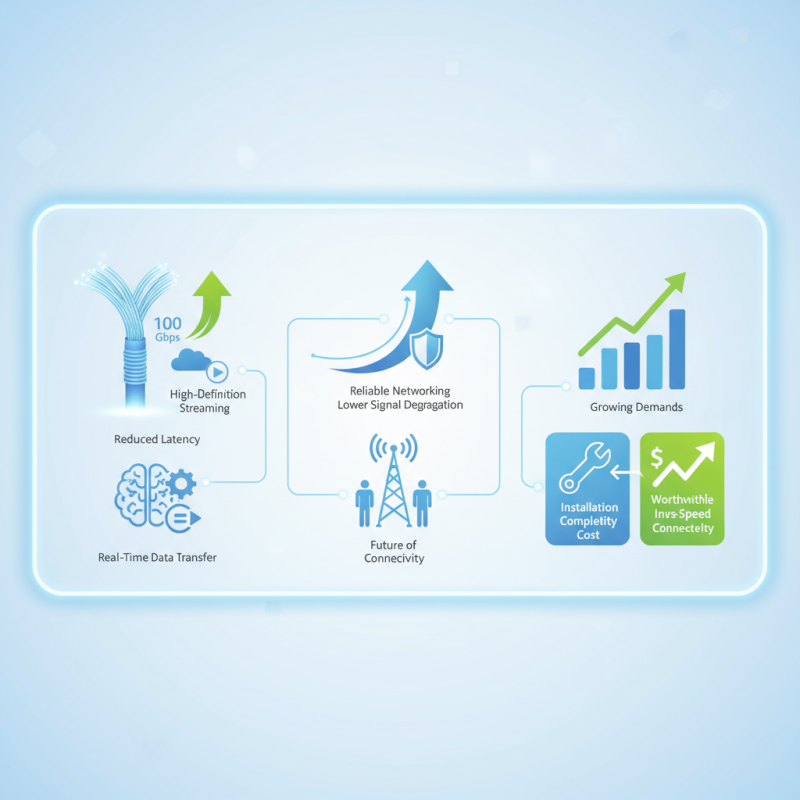
In today’s digital age, a robust and reliable networking solution is essential. Choosing the right medium can significantly impact performance. Fiber-optic Cables stand out due to their impressive bandwidth capabilities and speed. According to a report by the Optical Fiber Communications Conference, fiber-optic technology can transmit data at speeds up to 100 Gbps. This speed is crucial in supporting the growing demands of high-definition streaming and cloud computing.

Renowned industry expert Dr. Emily Chen emphasizes the importance of fiber-optic infrastructure: "The future of connectivity relies heavily on fiber-optic cables." Her insights reflect the industry's shift toward this advanced networking solution. Fiber optics not only enhance communication efficiency but also reduce latency, a critical factor for businesses relying on real-time data transfer.

While fiber-optic cables offer numerous advantages, including lower signal degradation over long distances, some challenges remain. Installation can be more complex and costly than traditional copper cables. Nonetheless, investing in fiber-optic technology often proves worthwhile. As more organizations seek high-speed connectivity, the choice of fiber-optic cables is increasingly becoming a foundational element of modern networking strategies.
Why Choose Fiber-optic Cable for Your Networking Needs?

Understanding Fiber-optic Cable: Basics and Functionality

Fiber-optic cables are revolutionizing the way we connect and communicate. Understanding their basics and functionality is crucial for making informed networking choices. These cables transmit data using light signals, enabling faster speeds than traditional copper cables. They consist of thin strands of glass or plastic, which allow light to travel long distances without significant loss.

The construction of fiber-optic cables is impressive. They have an inner core that carries the light, surrounded by a cladding layer. This cladding reflects light back into the core, preventing signal loss. It’s interesting to note that while fiber-optic cables provide higher bandwidth, installation can be more complex. The need for specialized skills often leads to potential mistakes during setup.

Maintaining fiber-optic systems does require expertise. Technicians must understand the cable's layout and performance characteristics. Even minor errors can lead to connectivity issues. Opting for fiber can be a fantastic decision, but it's essential to choose the right team for installation. The right knowledge can enhance performance and reliability, making this a worthwhile investment in the long run.

Why Choose Fiber-optic Cable for Your Networking Needs?

Dimension Description Advantages Use Cases
Speed High data transmission rates, up to several Gbps. Faster data transfer compared to copper cables. Data centers, ISPs, broadband services.
Distance Effective over long distances without significant loss of signal. Ideal for remote connectivity. Long-distance data transmission, WAN communications.
Interference Not affected by electromagnetic interference. Reliable signals in electrically noisy environments. Industrial settings, hospitals, and urban networks.
Security More secure than copper wiring; harder to tap into. Reduced risk of data breaches. Government facilities, financial institutions.
Maintenance Lower maintenance costs compared to copper. Longer lifespan and durability. Enterprise networks, technology firms.

Advantages of Fiber-optic Cable Over Traditional Copper Options

Fiber-optic cables offer significant advantages over traditional copper options. They deliver faster internet speeds, making them ideal for high-demand environments. Fiber optics transmit data using light, providing higher bandwidth compared to copper cables. This means more devices can be connected without sacrificing performance.

The durability of fiber-optic cables is also noteworthy. They are less susceptible to interference and environmental factors, like weather. This can lead to fewer outages and lower maintenance costs. One key detail to consider is installation. Fiber optics often require specialized skills. Ensure your installation team has proper training.

Tip: When choosing fiber-optic cables, verify the installation environment. Factors like distance and physical obstacles can impact performance.

While the benefits are clear, transitioning from copper to fiber can be challenging. The initial investment is higher, and the process may be complex. Reflect on your current infrastructure before making a decision. This ensures you align your upgrades with your actual needs.

Tip: Consult with networking professionals about your specific requirements. Their expertise can help guide you through the transition smoothly.

Applications of Fiber-optic Cables in Various Industries

Fiber-optic cables play a vital role in various industries. Their high-speed data transmission is crucial for sectors like telecommunications and healthcare. For example, hospitals rely on fiber optics for fast, reliable communication. This ensures that patient data is transferred quickly, facilitating timely care.

In the realm of education, fiber-optic technology enhances online learning. Universities use it to deliver high-quality video lectures and facilitate virtual classrooms. The clarity and speed of fiber-optic connections provide a seamless experience for students and teachers alike. On the other hand, some institutions struggle with implementation. They face budget constraints or lack technical expertise.

The entertainment industry benefits greatly from fiber-optic cables, especially in streaming services. High-definition content requires substantial bandwidth, which fiber optics can deliver. However, not everyone enjoys equal access. Rural areas often face challenges due to limited infrastructure. Making fiber optic technology universally accessible remains a pressing concern.

Factors to Consider When Selecting Fiber-optic Solutions

When selecting fiber-optic solutions, you should consider several key factors. One main aspect is bandwidth requirement. Fiber-optic cables offer significantly higher bandwidth compared to traditional copper options. For instance, a single-mode fiber can support up to 1 Gbps over several kilometers, while multimode fibers can provide 100 Gbps over shorter distances. This advantage meets the growing demand for data-heavy applications.

Another important consideration is distance. Fiber-optic cables can transmit data over longer distances without significant signal loss. According to a report by the Telecommunications Industry Association (TIA), fiber can maintain signal integrity over 40 kilometers, whereas copper cabling typically maxes out around 100 meters. This means fewer repeaters are needed, reducing overall costs.

Installation and environmental factors also play a critical role. Fiber-optic installation can be more complex and time-consuming than copper, which may lead to higher initial costs. However, the longevity and lower maintenance needs of fiber make it a worthwhile investment in the long run. Moreover, fiber is less susceptible to electromagnetic interference, essential in industrial environments. Balancing these factors is crucial for selecting the right solution for your networking needs.

Future Trends in Fiber-optic Networking Technologies

The future of fiber-optic networking technologies looks promising. As demand for faster internet speeds grows, fiber-optic cables are at the forefront. They can transmit data at extraordinary rates. Innovations are emerging, pushing the boundaries of performance.

One trend involves advanced modulation techniques. These techniques increase data capacity significantly. Research into photonics integration is also gaining traction. This could lead to more compact and efficient fiber-optic systems. The integration of AI in network management is another critical development. It allows for better traffic management and improved reliability.

While these advancements show great potential, challenges remain. Cost remains a barrier for many organizations. Infrastructure upgrades can be daunting. Additionally, while fiber offers speed, installation can be complex. There is a need for skilled professionals to manage these new technologies. Navigating these issues will shape the future landscape of fiber-optic networking.